

By Barry Roche on 22 Oct 2026
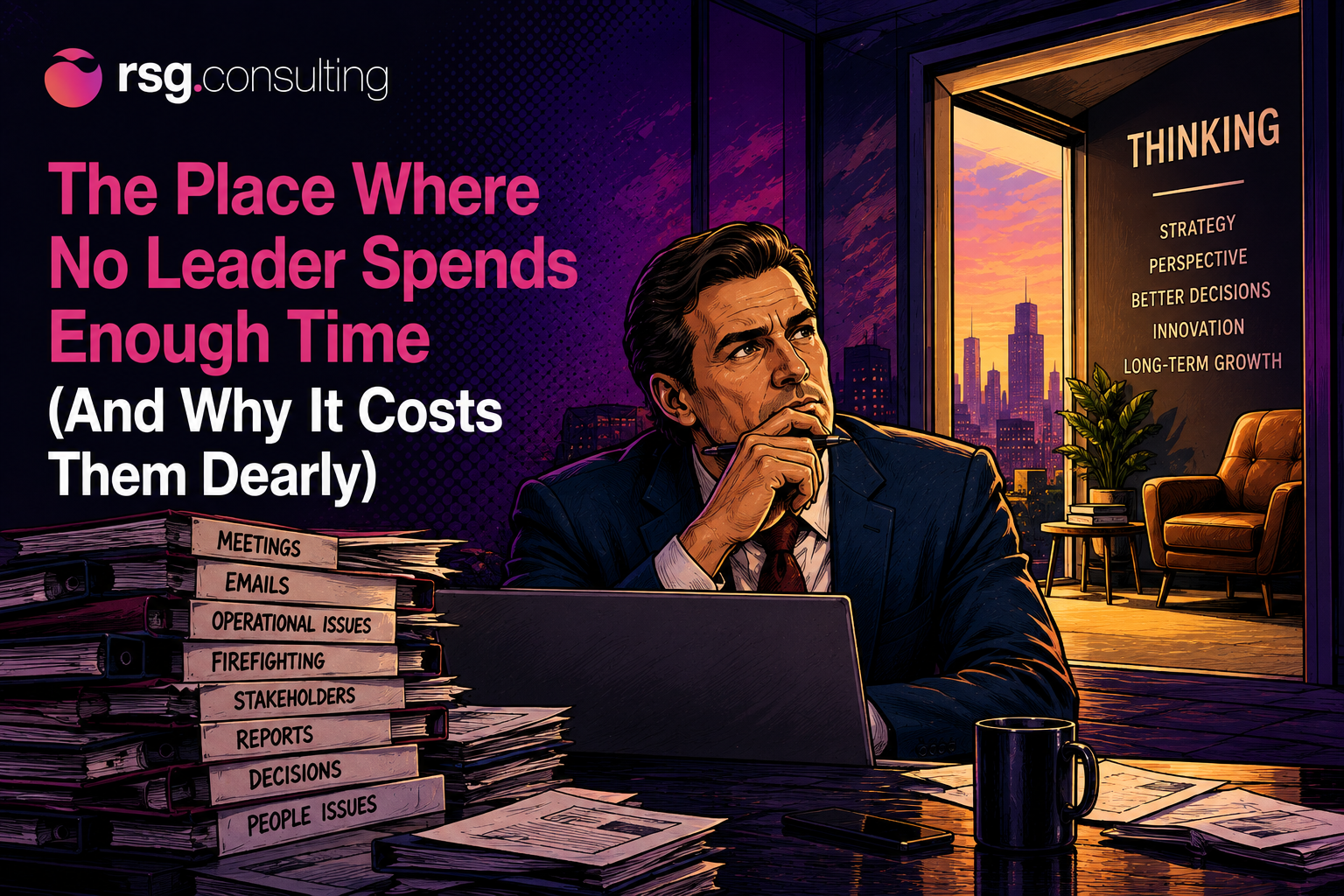
When I ask CEOs where their time goes, I get the same answer every time.

Meetings. Board updates. Investor calls. Numbers. Team issues. Fighting fires.
Then I ask: when did you last spend three hours just thinking about where the business should go next?
Silence.
Not thinking about this quarter's problems. Not reacting to what landed in your inbox. Just thinking. About direction, priorities, and what actually matters.
Most leaders haven’t done it in months; some, not at all this year.
This is one reason leaders struggle with strategic thinking: there is rarely enough protected time to step away from immediate demands and consider the bigger picture.
Why Strategy Gets Squeezed Out
According to research, most CEOs spend less than 20% of their time on genuine strategy work. The rest disappears into operations and firefighting.
It's not laziness. It's how businesses operate now. Everything moves faster. Investors expect quarterly updates. Teams need decisions. Problems can't wait.
But here's what happens: without space to think strategically, you end up optimising yesterday's plan whilst tomorrow's opportunities disappear. You're so busy running the business that you stop thinking about where it's actually going.
I've done this myself. Built businesses where I was constantly in motion but rarely stopping to ask whether I was moving in the right direction. You feel productive because the diary's full and problems are getting solved. But productivity isn't the same as progress.
If you never pause to ask whether you're doing the right things, you end up doing the wrong things very efficiently.
The Personality Factor
Some leaders struggle with strategic thinking more than others, and it's often personality-driven.
Hogan's research shows that certain personality patterns gravitate toward action over reflection. High scores on Bold or Mischievous often correlate with leaders who prefer doing to thinking. They're energised by movement, decisions, and visible activity. Sitting still to think feels uncomfortable.
Others score high on Dutiful or Diligent, which means they feel compelled to respond to every request and maintain every process. They struggle to step back because it feels like they're not pulling their weight.
Under pressure, these patterns intensify. The Bold leader makes faster decisions with less thought. The Diligent leader gets lost in detail. Neither creates space for genuine strategic reflection.
Understanding your own pattern matters because it determines what type of thinking time you actually need. Some leaders need unstructured space to generate new ideas. Others need structured time to challenge existing assumptions. Most never work out which one they are.
What Thinking Time Actually Delivers
When leaders protect time to think strategically, three things change.
- Clarity improves. You stop reacting to whatever's loudest and start focusing on what actually matters. Priorities become obvious. Distractions become easier to dismiss.
- Decisions get better. Strategic thinking time lets you test assumptions before they become commitments. You spot problems earlier. You see opportunities others miss.
- Energy returns. Constant reaction mode is exhausting. Strategic thinking, done properly, is energising because it reconnects you to why you're doing this in the first place.
But most leaders don't protect this time because it feels indulgent. The business is moving. People need answers. There's always something more urgent.
That's exactly why it matters. If you're only ever reacting, you're not leading. You're managing. And there's a difference.
How to Actually Create Thinking Space
This isn't about taking long walks or booking yourself into a country hotel for a week. It's about discipline.
- Block it like any other meeting. Three hours, once a week. Non-negotiable. Treat it as seriously as a board meeting because it's more important than most board meetings.
- Set a specific question. Don't just sit and "think about strategy." That's too vague. Ask: What assumption are we making that might be wrong? What are we not seeing? Where should we be in three years, and what needs to change to get there?
- Work with someone who'll challenge you. Thinking alone is useful. Thinking with someone who'll push back on your assumptions is more useful. That's where clarity actually comes from.
- Protect it from the urgent. The moment something urgent appears, thinking time gets sacrificed. That's a mistake. The urgent will always be there. The important only gets addressed if you make space for it.
Most CEOs say they don't have time for this. That's the problem. If you don't have time to think about where the business is going, you're already in trouble.
Where Most Leaders Go Wrong
The biggest mistake is treating thinking time as optional. Something you'll do when things calm down.
Things never calm down. If you wait for space to appear, it won't.
The second mistake is confusing thinking with worrying. Worrying is what happens when you're lying awake at 3am going over problems. Thinking is structured, deliberate, and focused on solutions.
The third mistake is doing it alone without challenge. Your own assumptions are invisible to you. That's why they're assumptions. You need someone who'll question them.
The Bottom Line
Leadership isn't about being the busiest person in the business. It's about being the clearest.
If you want better execution, start with better thinking. And if you want better thinking, you need to protect the time and space where it happens.
Most leaders know this already. The difference is whether you actually do it.
Struggling to find time for strategic thinking? Get in touch to discuss how we help CEOs create the discipline and space to think clearly about what matters most.

Share this
The Hard Truth: Great CEOs Need Great Coaching… But Do They Get It?
The Hard Truth: Great CEOs Need Great Coaching… But Do They Get It?
There's a hard truth most CEOs don't want to admit: at some point, experience stops being enough. The skills that got you here don't automatically tak …
11 Mar 2026
3
min read
The Strategy Execution Gap: Why Most Leadership Teams Know What to Do But Don't Do It
The Strategy Execution Gap: Why Most Leadership Teams Know What to Do But Don't Do It
Most organisations we work with don't have a strategy problem. They have an execution problem.
22 Jun 2026
3
min read
Why Getting Team Effectiveness Right Determines If Your Strategy Works
Why Getting Team Effectiveness Right Determines If Your Strategy Works
17 Mar 2026
3
min read