Book A Discovery Call
](https://hubspot-no-cache-eu1-prod.s3.amazonaws.com/cta/default/146904563/interactive-361265596618.png)](https://rsg.consulting/hs/cta/wi/redirect?encryptedPayload=AVxigLKLkh8nSkVa8yXThUyeE3LCqPpacBCf1pMC7%2FZ1gvcQdT7Un%2Fpi26MSVHtcFNd3swqHuTcmOiozyi4biDz%2BwHntWU6cf6SvJwYpKG2I1GZn1RH1U41ZZKXgcskMAGWGEJFBTAOEA2xa1s%2FifbO63GnLBJhi8Atlk0Ysaw2MEKYU5mViyLqlX5yUcM4sj1xURuTgrBg%3D&webInteractiveContentId=361265596618&portalId=146904563) [](https://rsg.consulting/hs/cta/wi/redirect?encryptedPayload=AVxigLKLkh8nSkVa8yXThUyeE3LCqPpacBCf1pMC7%2FZ1gvcQdT7Un%2Fpi26MSVHtcFNd3swqHuTcmOiozyi4biDz%2BwHntWU6cf6SvJwYpKG2I1GZn1RH1U41ZZKXgcskMAGWGEJFBTAOEA2xa1s%2FifbO63GnLBJhi8Atlk0Ysaw2MEKYU5mViyLqlX5yUcM4sj1xURuTgrBg%3D&webInteractiveContentId=361265596618&portalId=146904563) - [Services](https://rsg.consulting/services) - [Strategic Leadership Advisory](https://rsg.consulting/services/strategic-business-consulting) - [Executive Team Advisory for Corporate Leadership Teams](https://rsg.consulting/services/corporate-leadership-training-programs) - [Leadership Advisory for Founders and Growing Businesses](https://rsg.consulting/services/sme-training-programs) - [Start-Up Leadership Advisory](https://rsg.consulting/services/start-up-business-consultancy) - [Hogan Personality Assessments for Leadership Teams](https://rsg.consulting/services/hogan-assessment) - [Executive Coaching Powered by Hogan Personality Science](https://rsg.consulting/leadership-team-assessment) - [Board Performance & Composition Assessment](https://rsg.consulting/leadership-development-programs) - [About Us](https://rsg.consulting/about) - Resources - [Insights](https://rsg.consulting/blog/tag/insights) - [Blog](https://rsg.consulting/blog) - [The CEO's Guide](https://rsg.consulting/ceo-guide-to-building-high-performance-teams) - [Contact](https://rsg.consulting/contact) [](https://rsg.consulting) 1 Coldbath Square, Farringdon, London, EC1R 5HL [+442081388345](tel:+442081388345) [Connect with us on LinkedIn](https://www.linkedin.com/in/barry-roche-3436371a/) All Topics [All Topics](https://rsg.consulting/blog)[Insights](https://rsg.consulting/blog/tag/insights)[Hogan Assessment](https://rsg.consulting/blog/tag/hogan-assessment)[Corporate Leadership](https://rsg.consulting/blog/tag/corporate-leadership)[Podcasts](https://rsg.consulting/blog/tag/podcasts)[Corporate Coaching](https://rsg.consulting/blog/tag/corporate-coaching)[Strategic Management Consulting](https://rsg.consulting/blog/tag/strategic-management-consulting) # Do You Really Want a High-Performance Team? The Trade-Offs Few CEOs Consider By [**Barry Roche**](https://rsg.consulting/blog/author/barry-roche) on 27 May 2026 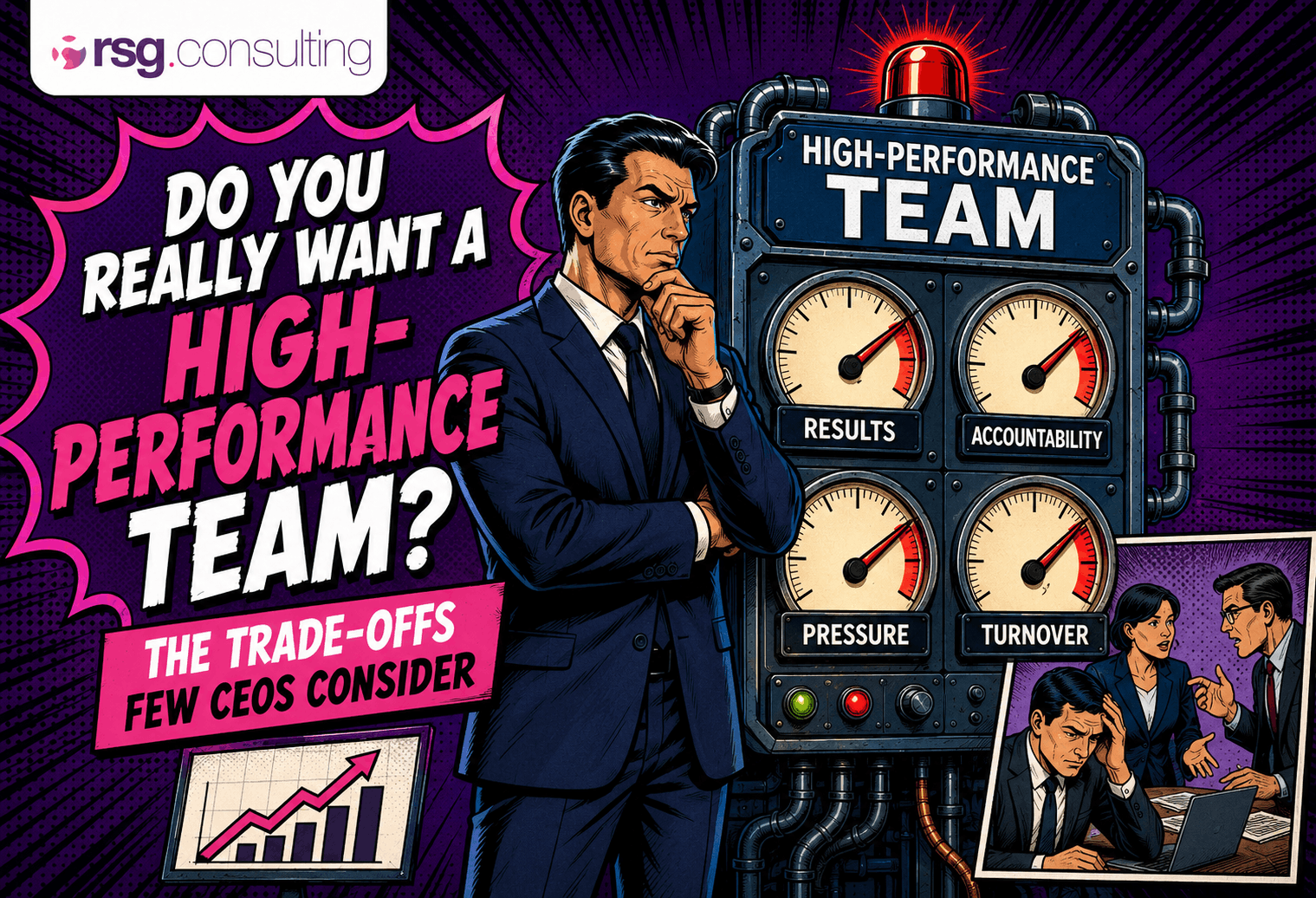 Every CEO says they want a high-performance team. But most haven't thought about what that actually means or what it costs. Because high performance isn't about working harder or pushing people further. It's about intensity, focus, and accountability. And not everyone wants to operate at that level. The question isn't whether you want high performance. It's whether you're willing to accept what comes with it. [](https://rsg.consulting/hs/cta/wi/redirect?encryptedPayload=AVxigLL9ci0JUAL6K4%2ByX%2BZdsNGnkoOYmuYalKml3nbRWmjW1krfXQkbAGATF6Tbk5LXpDJVZLDjt3v5GWz%2BPw66NxnOnoufyqZQXJI0A1%2B%2FkNgZofppxa%2FzHHubQ9%2BBKVqJnoo5cxESYt6YbRRygoCwEqoP%2FIys6CO8gDi%2BwXorROzPidAE4OackGYk8Cf0%2F2Xo0vrVgWvaCpioK5PPTw40qgCEJKhshtzwTyeHmsgdem0H82n9KpoZbmrtsU%2Bb6GoRbYIQfqpWD%2BSgou9cZ9boZbWdvUK3HDdEI8Y3pD07OWHmcHVWgV%2BAnIz1FwzwPEeBTm%2BRfoX04UdX971Sj0NCWM6CGBd%2BnqIPvAi6XsR%2Ffik%2FNJU7%2F1LeJFZebY%2BCfjy2qNG8zw5flyjOzHXgZ9J%2BAtr3SxjkrqC8pz5FkJnBtuwUhb4m5Dl3tEo%2FJB0ujvdn%2B6Mz4Atlc9A344QTQmg%2FNv%2BiH1LNscNY0Te5suu6OispNDHATng0HLlXsEFEp6GgpdcRyND0fMvc14lnHh4VxxKZOSMEoBGUs6VaaOoxhkrgGCQ0mZBIsV99pBxrAQxqI8cS83ApbqvDTmdeS7yDKMNOLSqJQatbvX5qE3Ou6i3VRdit%2FfUUok7q3ori7aKZWTOCQnMGpXeFBO1bmL7FrtG6Jbd%2B6kPNioU%3D&webInteractiveContentId=407840092379&portalId=146904563) ## **What High Performance Actually Requires** [High-performance teams](https://rsg.consulting/services/corporate-leadership-training-programs) aren't built on motivation or culture initiatives. They're built on clarity, discipline, and the willingness to have difficult conversations. That means clear priorities (not everything can be important), direct feedback (not waiting for performance reviews), and accountability (not excuses when things don't get done). [Most CEOs say they want this](https://rsg.consulting/blog/great-ceos-need-coaching). But when it comes to actually implementing it, they hesitate. Because high performance creates friction. It surfaces problems faster. It exposes underperformers more quickly. It makes the average look worse than it did before. And that's uncomfortable. ## **The Personality Factor** Not everyone thrives in high-performance environments, and that's not a character flaw. It's personality. Hogan's research on [team dynamics](https://rsg.consulting/blog/leadership-teams-strengths-weaknesses-hogan-assessments) identifies five important roles. High-performance teams need people in the "results" role; those who naturally drive toward outcomes and push for execution. But they also need people in other roles: relationships (maintaining cohesion), process (ensuring consistency), innovation (generating new ideas), and pragmatism (translating ideas into action). If you build a team entirely around intensity and urgency, you'll lose the people who provide balance. High performance isn't about everyone working at maximum intensity all the time. It's about having the right people in the right roles, working at their optimal level. ## **The Hidden Cost Nobody Talks About** Here's what most CEOs don't consider: high-performance teams have higher turnover. Not because people burn out (though that happens when it's done badly), but because high performers outgrow roles faster. They develop quickly. They want bigger challenges. They get recruited by competitors. That's the trade-off. You get better results whilst they're with you, but you can't keep them as long. Some businesses aren't set up for that. If your model depends on stability and long tenure, building a high-performance culture might create more problems than it solves. You need to know which you're optimising for: performance or stability. You can't have both at maximum levels. ## **When High Performance Becomes Toxic** The line between high performance and toxicity is thinner than most leaders realise. High performance becomes toxic when pressure replaces clarity. When people are working hard but don't know why. When targets keep moving without explanation. When accountability turns into blame. I've seen teams where the CEO demanded high performance but provided no structure to support it. No clear priorities. No feedback loops. No recovery time. Just relentless pressure and moving goalposts. That's not high performance. That's chaos with a label. The teams that sustain high performance have structure. They have clear metrics. They know what success looks like. They get regular feedback. And critically, they have periods of lower intensity built in, not as a luxury, but as a requirement. ## **What Actually Sustains Performance** Sustainable high performance comes from three things: clarity, capability, and rhythm. Clarity means everyone knows what matters most, what success looks like, and how their work contributes. Capability means people have the skills and resources to deliver at the level expected. Rhythm means understanding when to push and when to ease intense effort, followed by consolidation. The teams that fail are the ones that confuse intensity with performance. They push constantly, never pause to learn, and wonder why results plateau. ## **The Accountability Problem** High performance requires accountability, and most CEOs aren't willing to enforce it consistently. They'll set targets. They'll measure results. But when someone consistently underdelivers, they hesitate to act. Maybe it's a long-serving team member. Maybe they're well-liked. Maybe the timing's difficult. But if you tolerate underperformance, you don't have a high-performance team. You have a team with high expectations for some people and different standards for others. That destroys trust faster than anything else. High performance isn't sustainable without consistent accountability. Not blame, not punishment, just clear expectations and consequences when those expectations aren't met. ## **The Real Question** Most CEOs don't want genuine high performance. They want better results without the uncomfortable bits. Without the difficult conversations, without the turnover, without the accountability. But you can't have one without the other. So the real question isn't whether you want a high-performance team. It's whether you're willing to do what it actually takes to build and sustain one. Because if you're not, that's fine. Just don't pretend you are. ## **Get In Touch** If you want a team that performs consistently without burning out, we can help. [**Speak to our team**](https://www.rsg.consulting/contact) about building sustainable [high-performance teams](https://rsg.consulting/services/corporate-leadership-training-programs) that last and deliver results year after year. [](https://rsg.consulting/hs/cta/wi/redirect?encryptedPayload=AVxigLIuqk4%2FvMHNtC%2Fbls8rJIIUMdNrZdZi6VHpXfR7xHKEdoJgEqxnxDfwoREIysCwwU8rL42UnUELJ5reIgyl59RR3B6yy5FI5IIdapZJW58OPAEsHd7sipr%2FCSjXLmjSYsrDNHcXdNhIBRQ%2B3Apfq%2BRz%2FaaxY0M8acwqmykeC29wb5ae0QP3sCpdIGigVk7Nv%2Boho%2BFkSbs7gVBb7xuhHBH%2FKUq%2BZy4%3D&webInteractiveContentId=407780442323&portalId=146904563) - Recent - Topics - Archive Recent Topics - [Insights (17)](https://rsg.consulting/blog/tag/insights) - [Hogan Assessment (9)](https://rsg.consulting/blog/tag/hogan-assessment) - [Corporate Leadership (4)](https://rsg.consulting/blog/tag/corporate-leadership) - [Podcasts (2)](https://rsg.consulting/blog/tag/podcasts) - [Corporate Coaching (1)](https://rsg.consulting/blog/tag/corporate-coaching) - [Strategic Management Consulting (1)](https://rsg.consulting/blog/tag/strategic-management-consulting) See all Archive - [July 2026 (2)](https://rsg.consulting/blog/archive/2026/07) - [June 2026 (2)](https://rsg.consulting/blog/archive/2026/06) - [May 2026 (1)](https://rsg.consulting/blog/archive/2026/05) - [April 2026 (3)](https://rsg.consulting/blog/archive/2026/04) - [March 2026 (6)](https://rsg.consulting/blog/archive/2026/03) - [February 2026 (4)](https://rsg.consulting/blog/archive/2026/02) - [January 2026 (4)](https://rsg.consulting/blog/archive/2026/01) - [December 2025 (7)](https://rsg.consulting/blog/archive/2025/12) - [November 2025 (2)](https://rsg.consulting/blog/archive/2025/11) See all ### Subscribe by email Share this [Share on X](https://x.com/intent/post?url=https://rsg.consulting/blog/high-performance-teams-trade-offs&text=High-Performance+Teams+Trade-Offs+Every+CEO+Must+Know) [Share on Facebook](https://www.facebook.com/sharer/sharer.php?u=https://rsg.consulting/blog/high-performance-teams-trade-offs&t=High-Performance+Teams+Trade-Offs+Every+CEO+Must+Know) [Share on LinkedIn](https://www.linkedin.com/shareArticle?mini=true&url=https://rsg.consulting/blog/high-performance-teams-trade-offs&t=High-Performance+Teams+Trade-Offs+Every+CEO+Must+Know) Previous story [← The Leadership Paradox: Why Everyone Wants to Lead But Nobody Wants to Be Managed](https://rsg.consulting/blog/leadership-team-paradox-managers-avoid-management)Book A Discovery Call
](https://hubspot-no-cache-eu1-prod.s3.amazonaws.com/cta/default/146904563/interactive-361265596618.png)](https://rsg.consulting/hs/cta/wi/redirect?encryptedPayload=AVxigLKLkh8nSkVa8yXThUyeE3LCqPpacBCf1pMC7%2FZ1gvcQdT7Un%2Fpi26MSVHtcFNd3swqHuTcmOiozyi4biDz%2BwHntWU6cf6SvJwYpKG2I1GZn1RH1U41ZZKXgcskMAGWGEJFBTAOEA2xa1s%2FifbO63GnLBJhi8Atlk0Ysaw2MEKYU5mViyLqlX5yUcM4sj1xURuTgrBg%3D&webInteractiveContentId=361265596618&portalId=146904563) [](https://rsg.consulting/) - [Services](https://rsg.consulting/services) - [Leadership Team Assessment & Succession Planning Services](https://rsg.consulting/leadership-team-assessment) - [Leadership Development Programs](https://rsg.consulting/leadership-development-programs) - [About Us](https://rsg.consulting/about) - [Blog](https://rsg.consulting/blog) - [Insights](https://rsg.consulting/blog/tag/insights) - [Contact](https://rsg.consulting/contact) Copyright © 2026 RSG Consulting. Designed & developed by[JDR Group](http://www.jdrgroup.co.uk). - [Terms](https://rsg.consulting/terms-and-conditions) - [Privacy Policy](https://rsg.consulting/privacy) - [Cookie Policy](https://rsg.consulting/cookies-policy) ```json { "@context" : "https://schema.org", "@type" : "BlogPosting", "author" : { "@type" : "Person", "name" : "Barry Roche", "url" : "https://rsg.consulting/blog/author/barry-roche" }, "dateModified" : "2026-05-29T14:21:40.564Z", "datePublished" : "2026-05-27T09:30:00.000Z", "headline" : "High-Performance Teams Trade-Offs Every CEO Must Know", "image" : [ "https://rsg.consulting/hubfs/Do-You-Really-Want-A-High-Performance-Team-The-Trade-Offs-Few-CEOs-Consider.png" ], "mainEntityOfPage" : { "@id" : "https://rsg.consulting/blog/high-performance-teams-trade-offs", "@type" : "WebPage" }, "publisher" : { "@type" : "Organization", "logo" : { "@type" : "ImageObject", "url" : "https://rsg.consulting/hubfs/Screenshot%202025-10-03%20104424.png" }, "name" : "RSG Consulting" } } ``` ```json { "@context" : "https://schema.org", "@type" : "LocalBusiness", "address" : { "@type" : "PostalAddress", "addressCountry" : "UK", "addressLocality" : "London", "addressRegion" : "London", "postalCode" : "EC1R 5HL", "streetAddress" : "1 Coldbath Square, Farringdon" }, "alternateName" : "RSG Consulting", "contactPoint" : { "@type" : "ContactPoint", "areaServed" : "GB", "availableLanguage" : "en", "contactType" : "customer service", "telephone" : "+44 0208 138 8345" }, "geo" : { "@type" : "GeoCoordinates", "latitude" : 51.5246, "longitude" : -0.1083 }, "image" : "https://rsg.consulting/hs-fs/hubfs/startup.webp", "logo" : "https://rsg.consulting/hs-fs/hubfs/Images/logo.webp", "name" : "RSG Consulting", "openingHours" : [ "Mo-Fr 09:00-17:00", "Sa Closed", "Su Closed" ], "priceRange" : "£", "sameAs" : [ "https://www.linkedin.com/in/barry-roche-3436371a" ], "telephone" : "+442081388345", "url" : "https://rsg.consulting/" } ```