

By Barry Roche on 27 Aug 2026
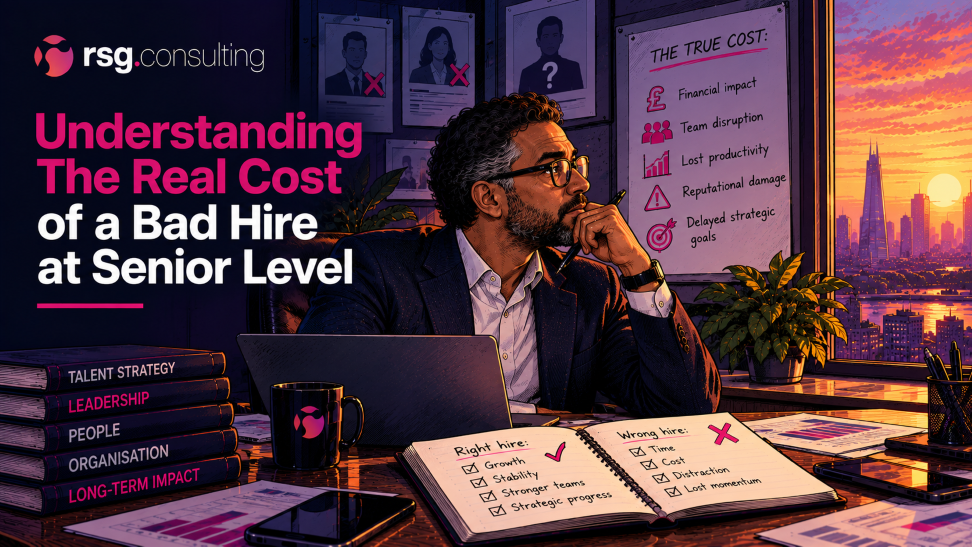 A bad hire at senior level is one of the most expensive mistakes a business can make. Not because of the visible costs, though those are significant, but because of everything that happens beneath the surface that never appears in a financial report.

Most organisations understand this in principle. Fewer actually do something about it before the appointment is made.
A robust recruitment strategy for senior level executives helps organisations identify potential risks before they become costly leadership mistakes.
The Numbers Are Only the Starting Point
Recruitment fees, salary, onboarding costs, the time spent managing a poor performer, and the cost of replacing them. These are real, and at senior level they add up quickly. Industry estimates typically put the direct cost of a failed senior hire at between one and three times annual salary.
But that figure doesn't capture the full picture. It doesn't account for the decisions that weren't made, the strategy that lost direction, the talent that left, or the momentum that stalled while the organisation managed the problem.
The visible costs are often the least damaging.
What Actually Gets Destroyed?
Senior leaders don't just occupy a role. They set direction, make decisions that cascade across the business, shape culture through their daily behaviour, and influence the performance of every team beneath them.
When a hire gets it wrong, the impact spreads in ways that are difficult to isolate and even harder to reverse.
Teams adjust to ineffective leadership, not by challenging it, but by working around it. In doing so, they develop habits and workarounds that persist long after the individual has gone. Trust erodes between departments because inconsistent communication and shifting priorities have made people cautious. High performers, the ones with the most options, start to look elsewhere.
None of this shows up immediately in a management report. It accumulates over months, sometimes years. By the time the problem is visible at board level, the damage is already significant.
Why Delayed Action Makes it Worse?
One of the most consistent patterns we see is organisations that recognise a senior hire isn't working, and wait.
They wait because of the sunk cost of the appointment. They wait because of the disruption a change would cause. They wait because they hope performance will improve. And occasionally, it does. More often, it doesn't. And every quarter of delay extends the period during which the organisation is absorbing the consequences.
The cost of inaction almost always exceeds the cost of acting decisively. The sooner a problem is identified and addressed, the smaller the damage.
Interviews Are Not Enough
The most common reason senior hires fail isn't that the selection process was careless. It's that it was incomplete.
Traditional hiring, interviews, CVs, references, tells you a great deal about what a candidate has done and how they present themselves under controlled conditions. It tells you considerably less about how they will actually operate when embedded in a complex organisation, managing a demanding team, and under sustained pressure.
The gap between how a candidate performs in an interview and how they lead in practice can be significant. And the behaviours that create problems, the ones that damage teams, misalign strategy, or erode trust, are rarely visible in a selection process designed to surface strengths.
The Role of Behavioural Insight
Personality and behavioural assessment changes what's measurable in a hiring process.
At RSG, we use Hogan assessments as a core part of senior hiring decisions for a straightforward reason: they give organisations insight into how a candidate actually makes decisions, how they lead under pressure, how they build, or damage, relationships at senior level, and what behavioural risks they carry.
This isn't about finding perfect candidates. It's about making more informed decisions. It's about knowing, before the appointment is made, where the risks lie, and whether they're manageable given the context of the role.
That information doesn't eliminate risk. Nothing does. But it dramatically reduces the probability of an expensive, avoidable mistake.
Protecting Long-Term Performance
The organisations that get senior hiring right consistently treat it as a strategic process, not a transactional one. They invest time in understanding what the role actually requires, not just the competencies on paper, but the behaviours needed to lead effectively in their specific context. They use structured insight to move beyond the impression a candidate creates, and they make decisions based on evidence rather than intuition alone.
This is why an effective recruitment strategy for senior level executives should combine behavioural insight with traditional assessment methods.
The result is better decisions, fewer costly mistakes, and leadership teams that are built to perform rather than built to look good on a chart.

Share this
The Strategy Execution Gap: Why Most Leadership Teams Know What to Do But Don't Do It
The Strategy Execution Gap: Why Most Leadership Teams Know What to Do But Don't Do It
Most organisations we work with don't have a strategy problem. They have an execution problem.
22 Jun 2026
3
min read
Why Getting Team Effectiveness Right Determines If Your Strategy Works

Why Getting Team Effectiveness Right Determines If Your Strategy Works
17 Mar 2026
3
min read
The Politics of Potential

The Politics of Potential
Studies show organizations with strong leadership are 13 times more likely to outperform their competition, and three times more likely to retain thei …
28 Jan 2026
1
min read